

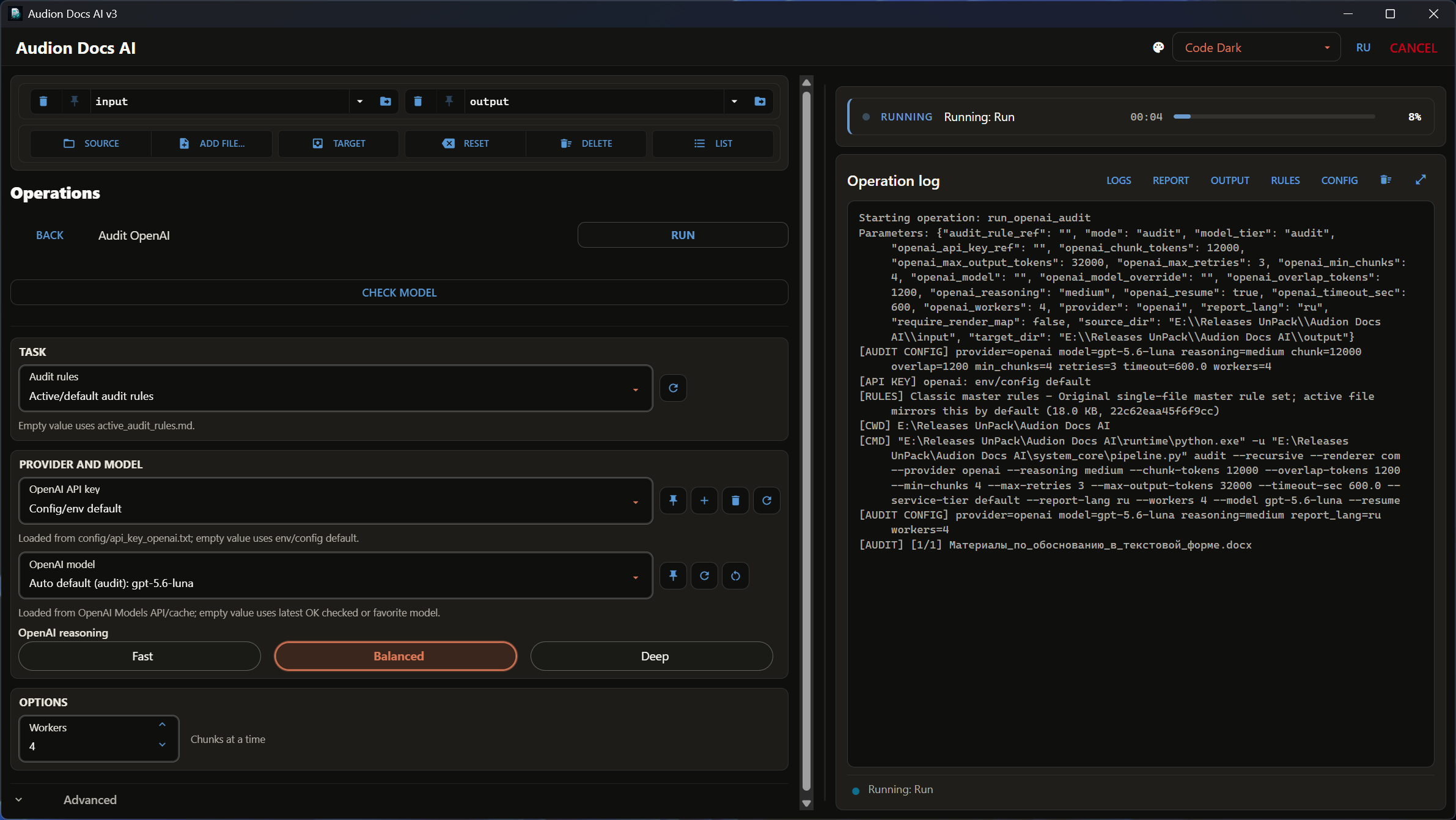
Die Regeln geben Sie vor, nicht das Programm: Geprüft wird nach Ihrer eigenen Vorgabe. Ein Auftrag geht über einen gemeinsamen Prompt an viele Dokumente zugleich, und das Modell wählen Sie selbst — vom schnellen bis zum stärksten. Das Programm extrahiert den Inhalt, erhält einen Bericht und normalisiert damit das ursprüngliche DOCX: Das Modell urteilt, die Skripte setzen jede Korrektur genau an die richtige Stelle.
3 Downloads über GitHubAudion Docs AI
Contents
- Why It Exists
- Principles
- Providers
- What Comes Out
- Next
- Technical Reference
- Running
- Settings
- Advanced Parameters
- Workbench Naming
Auditing documents with a language model and applying what it finds: Word and PowerPoint in, an error report and a corrected copy out.
Why It Exists
Proofreading a long document is work a model does well. Editing a document is work a model does dangerously: it will rewrite the whole paragraph, change things nobody asked about, and hand back a file where you cannot tell what moved.
So the two jobs are separated here.
parse → audit by the model → report → correctionThe model finds. The code fixes.
The audit reads the document and records what it found: where the error is, what the text was, what it should become, and how confident the model is. The correction step never calls the model again — it reads the existing record and applies only exact single replacements marked with high confidence.
Everything else — the uncertain, the arguable, anything needing a rewrite — is never applied. It stays in the report as a separate table of unresolved items.
Principles
Correction does not improvise. A replacement is applied only when both the exact original text and the exact new text are known. No "rewrite this paragraph better".
The cache is signed by the document. A model's answer is bound to the file's hash and the run parameters. Edit the file but keep the name, and the old answer will not be reused.
The model is never picked at random. With no model specified, the last successfully probed one is used, then the first favourite — but never an arbitrary string from the list the provider returned. A separate button runs a small probe of the chosen model and remembers the result with its date.
PDF is read-only. Text is taken from it for reports, but it is never edited: a PDF is an output, not a source.
The depth of the model's work is chosen explicitly. Each provider names it differently, and the program passes that provider's own parameter rather than a rough common one.
Providers
Four to choose from, switched in the window: OpenAI, Gemini, xAI, Claude. The key and the model sit together, the audit rules below, and there is a single action.
The application's standard models are gpt-5.6-luna, gemini-3.6-flash, grok-4.3, and claude-sonnet-5; whatever is chosen in the window or set by hand takes precedence.
What Comes Out
| file | what is inside |
|---|---|
| XLSX report | findings row by row: where, what, why |
| DOCX report | the same as a readable document, with the unresolved table |
| corrected copy | the document with the exact replacements applied |
| annotated copy | the original with anchors at places needing attention |
The source document is never modified — edits go into a copy.
Next
- User Guide — step by step.
tools\GUI_WORKFLOW_RU.md— the window and the order of work.tools\DOCUMENT_NORMALIZATION_RU.md— how correction works.tools\COMMA_LOWERCASE_RESTORE_RU.md— restoring commas and lower case.tools\TASK_PDF_EXTRACTION_RU.md— extraction from PDF into reports.
All four are Russian.
Technical Reference
Running
launcher_gui.cmd windowed
launcher_project.cmd command line, reports in English
launcher_project_ru.cmd the same in Russian
builder_main.cmd environment build, checks, releaseSettings
config\llm_settings.yaml — chunk sizes, retries, timeouts, names of the rule files. There are no separate launchers per provider pair any more: everything is chosen in the window.
Advanced Parameters
Hidden in a collapsible block — chunk size and overlap, minimum chunk count, retries and timeouts, manual model override, resuming from where a run broke, render-map strictness. The main path is not cluttered with them.
Python runs unbuffered, so the configuration and the progress of each chunk appear in the log immediately rather than after completion.
Workbench Naming
One shared vocabulary across all Audion projects: Source, Add file…, Target, Reset, Delete, List. In Russian: Источник, Добавить файл…, Назначение, Сбросить, Удалить, Список.
Das Programm ist portabel: der entpackte Ordner ist das installierte Programm. In die Registry wird nichts geschrieben; zum Entfernen den Ordner löschen.
$name = "Audion_Docs_AI_v1.9.4_Full.zip"
Invoke-WebRequest "https://audion.dev/get/docs-ai/1.9.4/Audion_Docs_AI_v1.9.4_Full.zip" -OutFile $name
Invoke-WebRequest "https://audion.dev/get/docs-ai/1.9.4/Audion_Docs_AI_v1.9.4_Full.zip.sha256" -OutFile "$name.sha256"
$want = (Get-Content "$name.sha256").Split(" ")[0]
$have = (Get-FileHash $name -Algorithm SHA256).Hash.ToLower()
if ($want -ne $have) { throw "Prüfsumme stimmt nicht: der Download ist beschädigt" }
Expand-Archive $name -DestinationPath ".\docs-ai"