

Sync Tools
github.com/Tensionix/sync-tools ↗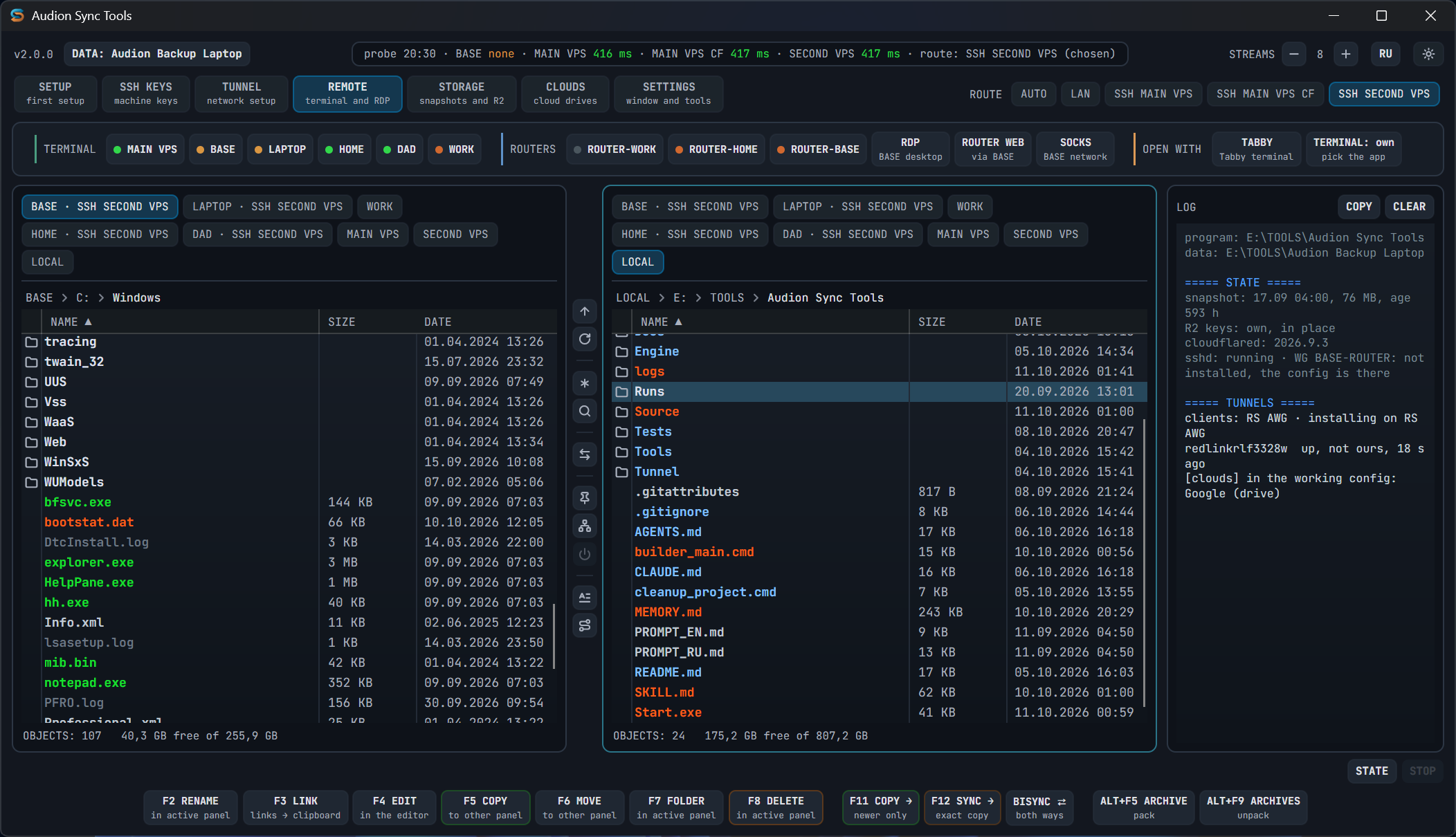
A server makes its own backup, but only your machine can fetch it home. Audion Sync Tools keeps that mirror on your disk and, beside it, everything needed to make use of it: the SSH keys and the keys to the R2 storage, the tunnel client, the routes to the machines at home and at work. The program and the data are kept apart: the program is restored from a release, the data live in a folder of the machine. Two file panels read a local disk, a machine over SSH, R2 and cloud drives alike, and anything can be copied between any two of them. After Windows has been reinstalled it is enough to name the former data folder: the keys, sshd and the access to the machines come back at one button. Its own rclone, cloudflared, terminal and PowerShell lie in the same folder; the program sets up no task in the Windows Task Scheduler.
Audion Sync Tools
Contents
- Where to start
- What lies where
- The window
- Colours
- Routes to the home machines
- Documentation
- Rules worth knowing in advance
- OpenVPN from the data folder
The program that keeps a copy of MAIN VPS on this machine, together with everything without which that copy is useless: the keys, the tunnel client, the access to the home machines. Plus a snapshot of the private Build-stack archives in the R2 bucket.
Nothing leaves it for the outside: no cards, no releases, no repositories. Publishing is the work of Audion Build Publisher.
Where to start
After Windows has been reinstalled: choose the former DATA FOLDER, then SETUP → RESTORE. Before formatting, run SSHD once to save the host keys into DATA. The order, the limits and the CLI: restoring Windows.
Start Start.exe. The window asks for administrator rights once — they are needed to work with the system network connections: the tunnel service, the state of the WireGuard interfaces and their handshakes are given by the system only to an administrator. You may refuse: everything but the tunnels works without the rights.
On a new machine the order is this:
- unpack the program and bring this machine's data folder with it —
Audion Backup <Machine>;
- start
Start.exe: the first-run window asks for the data folder and
downloads the tools a release comes without — rclone, cloudflared, the terminal, PeaZip and the editors;
SETUP→IMPORT KEYS— lays the keys into the three places the programs
look for them; Runs\import-keys.cmd does the same;
STORAGE→SYNC ALL— the first filling of the mirror. After that the
mirror is refreshed by the same button or by Runs\sync-backup.cmd: the program creates no tasks in Windows Task Scheduler, and MAIN VPS takes its nightly snapshot itself, by its own timer.
To confirm it all landed: the DIAGNOSTICS button in the TUNNEL section, or Tunnel\RemoteDesktop\check-routes.cmd from a console.
What lies where
The program is this folder: the window, the scripts, its own rclone, the tunnel client. There is not a single file here that would be painful to lose: no keys, no addresses, no passwords — only a pointer to the profile.
The data is the neighbouring Audion Backup: snapshots, six mirrors of MAIN VPS's code, keys, tokens. There is not a single executable file there.
The machine profile is the data folder itself: every machine has its own, for example Audion Backup Laptop or Audion Backup Work. It holds what makes this machine differ from the same program at another person's: rclone.conf, the R2 keys, the host fingerprints, the addresses of the machines, the plan of the mirror, the router password. The settings of the window — the theme, the language, the terminal — are part of the program and do not go into the profile.
The name of the profile is given by a person — Laptop, Work, Base — because the data folder is carried between machines, and the name of a computer at work cannot be changed. The program itself keeps only a pointer to the profile: config\profile.json, two lines. Everything else it takes from the profile and writes back there.
The working files of the connections lie only in the data folder: the program does not keep them. To see them as a list, use the LIST button in the SSH KEYS section.
The path to the data is counted from where the program lies. If the data lies elsewhere, the path is given by the -Root switch — of the window and of every wrapper. No drive letter is hard-coded anywhere: on the laptop it is E:, on the workstation S:.
Start.exe starts the window Runs\sync-backup.cmd the mirror of MAIN VPS Runs\import-keys.cmd lay the keys out Runs\export-keys.cmd collect Export Keys into Tunnel\Export Runs\backup.cmd PRIVATE BACKUP: the Build-stack archives into R2 App\ the window and its own PowerShell 7 Engine\ the scripts Tunnel\ the tunnel client Tunnel\RemoteDesktop\ access to the machines, the router, the routes Tools\ rclone, the terminal, PeaZip, the editors config\ the version, the pointer to the data folder, the settings of the window logs\ the logs of the window and of the wizards
The window
Two file panels are always visible, and the section strip at the top changes only what is open in them and which row of buttons is shown: SETUP, SSH KEYS, TUNNEL, REMOTE, STORAGE, CLOUDS and SETTINGS. On the right is the log, between the panels a narrow strip of buttons, at the bottom the row of file operations with their keys. A local disk, a machine over ssh, an R2 bucket and a cloud are the same to the program: one rclone reads them all, and copying goes between any two sides.
In the header: the DATA badge with the name of the data folder, the probe line (which route answered in how long, and which way the window will go), the number of threads, the language RU / EN and the theme button: Audion Vault Dark, Audion Dark, Audion Code Dark and Audion Light. The choice is remembered between runs.
The SETUP and SSH KEYS sections show what this machine has already got: the addresses of the machines, the ssh keys, the keys to R2, the list of host keys, sshd, the router password. Every button has an indicator: grey — this is not there yet, orange — it is there but not confirmed by doing, green — confirmed by reading a panel. REMOVE TASK stands apart: it removes the daily task left from former versions, and is visible only while such a leftover exists.
The machines — BASE, LAPTOP, MAIN VPS, HOME, WORK and the routers — stand in the REMOTE section: the button of a machine opens a terminal on it. The set of buttons is given by targets.json; a machine whose address is not written in yet has a grey indicator, and a press says so in words. MAIN VPS stands in the panels beside the home machines and the R2 bucket: a file travels between the R2 bucket and MAIN VPS directly, with no scp and no console.
The keys are those of a file manager: Space marks, Enter goes in, Backspace goes a level up, Tab moves to the other panel. F2 — rename, F3 — public links to what is marked in the R2 bucket, F4 — the editor, F5 and F6 — copy and move, F7 — a folder, F8 — delete. F11 adds what is missing to the other panel, F12 makes it an exact copy of the active one. Alt+F5 and Alt+F9 pack and unpack archives, Ctrl+F searches from the folder of the panel downwards, the F key narrows the list by name. Esc stops the running operation.
The asterisk in the strip between the panels marks rows by masks: masks of one's own, saved sets, the time of change and groups of extensions. The magnifier opens the search — the same on a disk, on a machine, in the R2 bucket and in a cloud; what is found can be put into a panel as one flat list.
The STATE button under the log reads the panels again and writes a summary: the age of the snapshot, the R2 keys, the version of cloudflared, sshd and the tunnels of this machine — its own and those of someone else's VPN. The same summary appears at start.
The program carries its tools with it and updates them itself: SETTINGS → UPDATE looks after rclone, cloudflared, the terminal, PeaZip and the editors. Versions are asked before anything is downloaded, so what is already fresh is not downloaded again. The data folder, the font, the transparency and sizes shown in bytes are there too.
In detail — in the user guide.
Colours
The names of files and folders are coloured by App\config\colors\themes.json: it holds the colours and the order of the rules for the dark and the light sides. What counts as video, a document or an archive is said by App\config\mask-groups.json next to it — the same families as in the mask window; there is no second list of extensions in the program. The colours are taken from the owner's Total Commander themes.
The rules go from top to bottom, and the first that fits wins — as in TC itself. So freshness usually matters more than type: a file changed today is coloured "not older than a day" even if it is an archive. Age counts in calendar days: yesterday's file is "not older than a day" even when it is thirty hours old.
The colours of the window itself — the frames, the buttons, the background of the list — live apart, in the themes of the window, and do not affect the colours of the rows.
Routes to the home machines
From home everything goes directly. From someone else's network — through the jump host MAIN VPS: first by name, then over cloudflared, and SECOND VPS stays as the last. The route is chosen by the probe, and the ROUTE buttons in the section strip let you insist on your own: AUTO, LAN, SSH MAIN VPS, SSH MAIN VPS CF, SSH SECOND VPS. The caption of the source above a panel says which way the call goes: BASE · SSH MAIN VPS CF. Where the common choice does not fit, a button in the strip between the panels gives each machine a route of its own.
Documentation
README.md the pointer to the descriptions and the guides Docs\README_EN.md this description Docs\README_RU.md the same in Russian CLAUDE.md the rules of working with the project MEMORY.md the history: why it is built this way SKILL.md commands, checks, configs Docs\USER_GUIDE_EN.md the user guide Docs\USER_GUIDE_RU.md the same in Russian Docs\RESTORE_EN.md restoring after Windows has been reinstalled Docs\RESTORE_RU.md the same in Russian Docs\CHANGELOG_EN.md the changelog Docs\CHANGELOG_RU.md the same in Russian
The register of accesses — which key opens what, where which tunnels are — lives in the data: Audion Backup\Tunnel\ACCESS.md. The values of secrets are never copied there, only paths and purposes.
Rules worth knowing in advance
Take nothing from the neighbouring projects. The program has its own rclone and its own keys; a change that brings back a tie to the neighbours is a wrong change.
Do not clean the data. Audion Backup is not deleted and not "put in order": the keys, the tokens and the only local copy of MAIN VPS are there.
A button calls a wrapper. Nothing must happen in the window that cannot be done from a console — otherwise the window and the wrappers drift apart.
The owner edits the keys. The program repairs permissions and paths, the content of the keys — never.
OpenVPN from the data folder
TUNNEL → NET → OPENVPN offers to connect the VPN and open the disks of WORK in the active panel, or to disconnect the chosen VPN profile. After the request to connect, the program waits up to 90 seconds for work:/ to be read through rclone, with the keys and the server check of the working rclone.conf. A sign-in error does not count as a ready connection. On a new machine IMPORT KEYS, RCLONE.CONF and the trusted keys of WORK are needed first. SETUP → OTHER → OVPN PATH lets you choose the client and the profile; Ctrl+OPENVPN checks the paths without connecting. The same is available through Tunnel\RemoteDesktop\openvpn.cmd and openvpn-path.cmd with the -Root switch.
The portable layout: DATA\OpenVPN Portable\openvpn-portable.exe, app beside it, the profile in data\config\*.ovpn, the RDP file next to the client. The owner provides these files; they are not part of a Sync Tools release. If the system OpenVPN GUI is installed, it is found automatically; an explicit choice of the client is saved in the data and takes priority. The external client is started through UAC. To disconnect, use the same OPENVPN button or the client's tray icon; STOP is meant for file operations. The CLI has -Connect and -Disconnect. OpenVPN gives the route to WORK; the SSH/SFTP connection for the panels is made by rclone. Simultaneous VPN connections from different machines need profiles allowed by the administrator of the server: copies of one certificate may push each other out.
The program is portable: the unpacked folder is the installed program. Nothing is written to the registry; to uninstall, delete the folder.
$name = "Audion_Sync_Tools_v2.0.1_Full.zip"
Invoke-WebRequest "https://audion.dev/get/sync-tools/2.0.1/Audion_Sync_Tools_v2.0.1_Full.zip" -OutFile $name
Invoke-WebRequest "https://audion.dev/get/sync-tools/2.0.1/Audion_Sync_Tools_v2.0.1_Full.zip.sha256" -OutFile "$name.sha256"
$want = (Get-Content "$name.sha256").Split(" ")[0]
$have = (Get-FileHash $name -Algorithm SHA256).Hash.ToLower()
if ($want -ne $have) { throw "checksum mismatch: the download is corrupt" }
Expand-Archive $name -DestinationPath ".\sync-tools"